
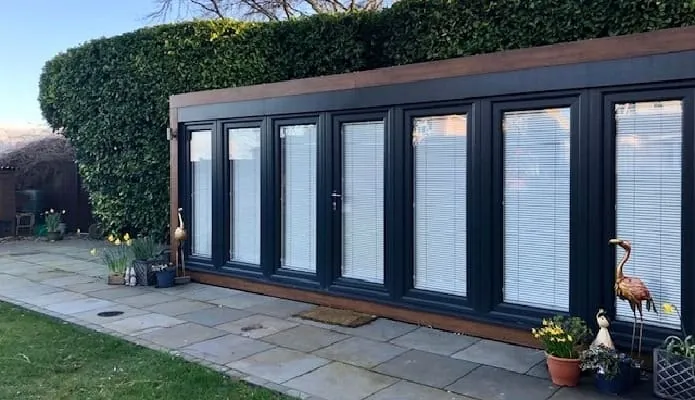
Garden Offices
A proper garden office not a shed with a desk.
No commute, no lease, no planning permission. A fully insulated garden office that's ready to work in within a day — and needs zero maintenance for decades.
- 25 Year
- Guarantee
- Free
- England Delivery
- Zero
- Maintenance
The Range
The garden office range: QCB5 & QC9
Two specifications, every size from a compact 6ft × 6ft pod up to a 33ft-wide studio. The QCB5 is the UK's best-selling zero-maintenance garden office; the QC9 adds a 2ft (600mm) flyover roof on the frontage with downlights, inside and outside, for a classic luxury look — all included in the QC9 price.
Every office is built from cladding that never needs painting or staining, A-rated double glazing, and full insulation for year-round use — backed by our 25-year structural guarantee.
At a glance
The essentials
- ✓ Installed in a single day
- ✓ No planning permission (permitted development)
- ✓ Exterior — zero maintenance for 25+ years
- ✓ Fully portable — relocate it if you move home
- ✓ Free delivery and installation in England
- ✓ £100 deposit reserves your installation date
And, like every Booths building
A zero-maintenance exterior
Built from steel and UPVC — no external timber. It never needs painting or staining, so you are never left maintaining a building, and it keeps its just-installed look for the full 25 years.
The UK’s only 25-year guarantee
A 25-year structural guarantee on the building itself — not a one or two-year warranty. It is built, and warranted, to be used for decades rather than treated as a temporary garden room.
Portable — and still an asset
Every building is 100% portable. If your circumstances change it can be lifted out and relocated, or sold on, so it stays a resaleable asset rather than money sunk irreversibly into the house.
And finished the same inside — plastered walls, real flooring and full electrics, whether you buy or rent. See interior photos
Our Office Range
Choose your specification
Two specifications, every size from a compact pod to a 33ft studio. Prices include free delivery and full installation in England, and our 25-year structural guarantee.

QCB5 Garden Office
6ft wide to 32ft wide
Inc. VAT, delivery & installation
The UK’s best-selling zero-maintenance garden office, in a size for every garden.
See full details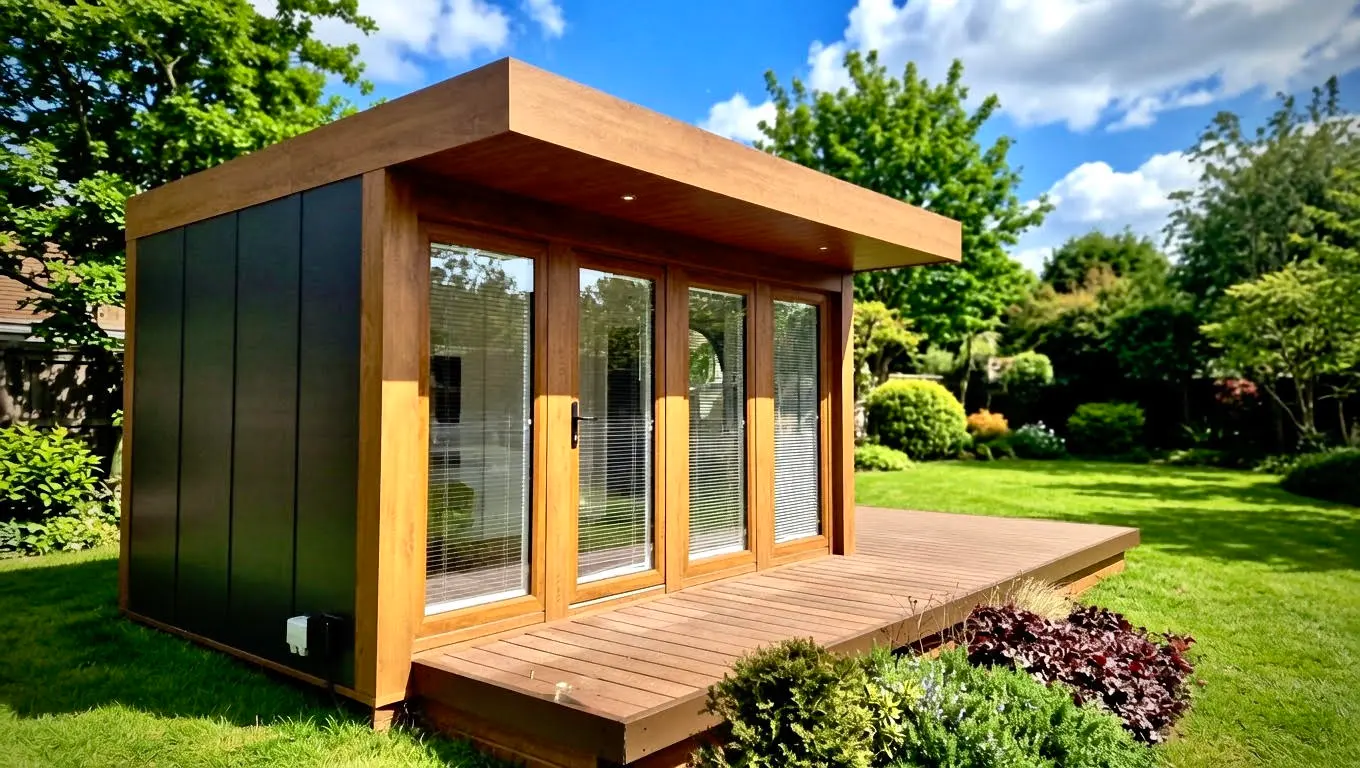
QC9 Garden Office
6ft wide to 33ft wide
Inc. VAT, delivery & installation
Enhanced specification — now includes a 2ft flyover roof on the frontage with exterior downlights, plus integrated ceiling downlights inside.
See full detailsAll prices include VAT, free delivery and installation in England. View all sizes & rental options →
Customer Stories
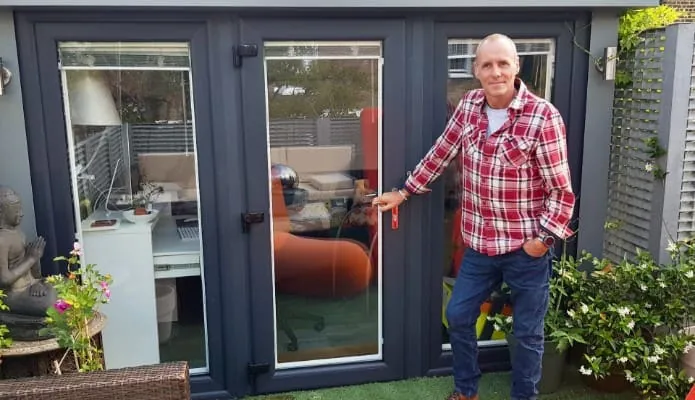
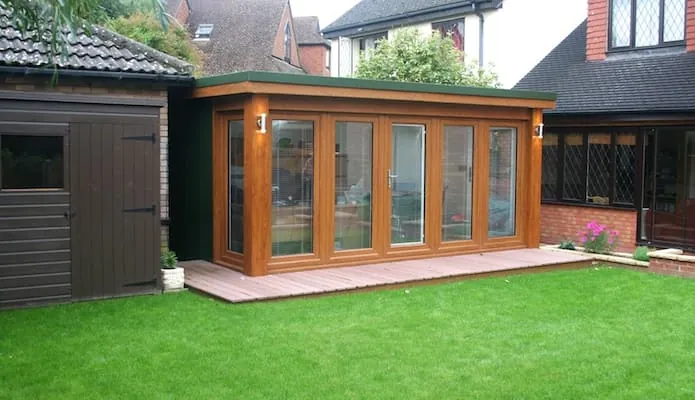
Garden offices in the wild

Frequently asked questions
Where does the external air-conditioning unit go?
The outdoor unit sits on the ground on slabs rather than on the studio wall, so its vibration is never felt inside. It needs roughly one metre of clearance in front to work. As it isn't the prettiest box, it's usually placed on the least visible side, and the pipework can be extended to run it further from the building and out of sight.
Can the studio be air-conditioned, and how does it work?
Yes — a single air-conditioning unit does four jobs: heats in winter, cools in summer, dehumidifies, and filters the air. It's a heat-exchange unit, so it's roughly four times more efficient than a standard electric heater (you put in around 1–1.5kW and get 5–6kW of heat out), which makes it cheap to run. We recommend it over underfloor heating, which can't cool in summer and limits where partition walls or a toilet can later be added.
We want an art studio — is it suitable?
Yes — many customers use the studios for art and comment on the light, airy feel. Windows on two sides are common; a three-side window option is available.
Can I attach a garden studio to my house?
No — studios, offices and annexes cannot be attached to existing properties, though they can be positioned within about 2 inches of one.
Is the base strong enough?
Yes — a decoupled floor accommodates movement (helpful for treadmills/ cross-trainers). Non-moving heavy items (bookshelves, pool tables, printing machinery) are easily handled; discuss heavy moving gym equipment with us.
Can I have elaborate or multi-level decking?
Yes. We make our own decking in standard front depths, but for more elaborate work — multiple levels, steps, or decking wrapping right around the studio — we can put you in touch with a specialist decking installer who handles the bespoke design and materials.
Can you supply a more bespoke garden office design?
Yes — half windows, high "fan light" windows, decoupled treadmill flooring, external downlights, internal partitions/sliding doors, extra decking, colour options, light oak walls, French doors, flyover roofs, floor and outside sockets, internal storage or toilet cubicles. Contact us for option pricing.
Do you supply bi-fold doors?
No. Bi-fold doors have fine tolerances; very hot weather expands them, making closing or locking difficult or impossible.
Do you supply blinds?
Recessed blinds are included as standard in QCB5 and QC9 layouts.
How close to a fence or boundary can the studio be built?
Very close — we can build to within about an inch of a fence on either side. The wall panels are fixed from inside, so we don't need working space around the outside, which means you can use almost the full width of a narrow garden. Because the building is maintenance-free, there's no need for external access afterwards either. (See also the fire-safety note on boundaries.)
Can I paint my garden studio?
The outside never needs painting or staining — a low-carbon, eco-friendly design. Inside, you can paint over the factory white base coat in any colour.
What colours are available?
Windows: light oak or anthracite grey. Walls, corner pillars, fascias and soffits: Merlin grey (light), anthracite grey (dark), juniper green, or oak (expensive, 5-year guarantee). Standard: anthracite windows with Merlin grey walls.
Do I need a concrete base?
No. Studios sit on an adjustable chassis on feet made from a recyclable composite material, resting on soil, grass or gravel — significant cost savings, installable on sloped ground, and a lower-carbon alternative to a concrete base.
Can you fit decking?
Yes — long-lasting, less-slippy decking (30-year manufacturer lifespan), safer than timber. Standard front depths 910mm (3ft), 1220mm (4ft) or 1820mm (6ft), in brown or grey.
Do I need planning permission for decking?
Yes if the decking is 300mm or more above ground; no if below 300mm.
Do you deliver to Scotland, and what does it cost?
Yes. Delivery and installation are free throughout England. To Scotland it's a flat £899 within 100 miles of Edinburgh or Glasgow — this applies to purchases only, as we don't offer rentals in Scotland. Beyond that radius — the Highlands, the islands or anywhere needing a ferry — call John Doolan, our Edinburgh-based installer, on 07752 489111 for a quote.
Can the studio go through a house or where access is difficult?
Yes (a small charge applies). Designed for difficult/London access — normal door-size access is required. Fitters have never failed an install due to access; very long flyover-roof components may be an exception.
Do I actually need air conditioning?
It depends which way your windows face. North-facing windows get little direct sun, so air conditioning is a nice-to-have rather than a necessity. South-facing windows — or windows on several sides — take sun for most of the day and can get very hot, so we'd recommend it. Checking your studio's likely orientation on Google Earth is a quick guide.
Do you do site visits?
Not normally needed — the base design handles nearly any garden regardless of slope or surface, accommodating up to 1 metre of slope without expensive excavation and with no concrete base. Visits are conducted occasionally depending on the situation.
What is the door width when opened?
The door width when opened is 760mm; the door frame is 910mm wide.
Is the studio double-glazed?
Yes — low-energy A-grade sealed units, thermally equivalent to triple glazing, with enhanced sound insulation.
Can my studio be made larger later?
No — take time choosing the size. The only size feedback we get is "wish we'd gone bigger", so buy the biggest you can accommodate.
What are the exterior walls made of, and do they need maintenance?
The walls are 75mm-thick galvanised steel-clad panels (Corus/Tata steel) finished in a tough leather-effect plastic coating that won't fade or rot. Maintenance is essentially nil — an occasional wipe-down is all that's needed, and the colour looks the same after eleven years as on day one. The cladding is secret-fixed, so there are no visible or removable fixings from the outside.
Is the studio fire-safe, and can it go close to a boundary?
Yes. Because the building is clad in non-combustible galvanised steel rather than timber, it doesn't carry the fire-spread risk of a timber building — the cladding cannot catch fire. That can matter under building regulations near a boundary, where a timber building may be considered too close to a neighbouring structure. Always confirm the specifics with your local building control.
Can I fix heavy items to the walls?
Yes — thick CLS studding at the wall joints secures heavy items (TVs, speakers); lighter items can go anywhere on the MDF walls.
What flooring do you install?
Commercial-grade waterproof vinyl. Office chairs with castors eventually abrade almost any flooring, so a protective mat is recommended.
What is a flyover roof?
A flyover roof is a canopy that extends out beyond the studio — typically from 900mm up to 2400mm — on a support post, giving shade and shelter (handy for getting the key in the door out of the rain). It can go on any side, looks smart paired with decking, and has its own guttering with the downpipe hidden through the support post.
Do you offer French doors?
Yes. French doors are 6ft (1829mm) wide and use a "floating transom", so there's no central post in the way when both doors are open. They are multi-point locking and secure; in normal use one door stays bolted top and bottom while the other is the working door. An adjustable restrictor holds the doors steady against wind and can be released — with a hook — to swing them fully back.
What is a fused spur, and where is it used?
A fused spur is a neater, safer alternative to a socket, with the cable run hidden behind the wall — used for fixed appliances such as an air-conditioning unit or a heater. In wet areas like a bathroom a standard socket isn't permitted, so a fused spur is used instead.
Is the glass safe?
Yes — toughened and compliant with British standards.
What heating do I need?
We recommend air conditioning via Booth's Electrical Services — heats in winter, cools in summer, low running cost, 5-year guarantee (service every 2 years, ~£200+VAT). Installation is around £1,700. Alternatively, two cheaper electric heaters.
How do I buy a garden studio or garden annexe?
Pay a £100 refundable deposit for studios, or £1,000 non-refundable for annexes, to reserve your installation date. You receive a floor plan and costings by email and finalise the design with one of our advisors. The design must be confirmed 15 working days before installation or the date shifts. Payment begins when the groundworks team arrives. For annexes, an advisor visits to assess groundworks and utilities. Factory visits are available in Corby, NN18 8AN.
How long will my garden studio last?
Truly zero maintenance, never requiring painting or staining, with an expected lifespan well over 25 years. A QC2 bought in 2009 still looks installation-new. Booths stopped supplying timber in 2012.
How many sockets are fitted?
Six double sockets at ~450mm from the floor are included; extras £30 each. High sockets (~1150mm), cooker sockets and floor sockets are available. The consumer unit includes a double socket.
What is the ideal size?
Consider larger than you first expect — the most common feedback is "wish we'd gone bigger", and larger studios usually offer better value per square foot. Draw the floor plan to scale with cut-out furniture to test layouts.
How long does installation take?
Small studios: one day. Larger: 2–3 days. Very large: 5–6 days. Winter days are shorter and weather can extend timeframes.
What is the internal finish?
Grey vinyl flooring (oak vinyl available), white MDF walls and ceiling, six double sockets at 450mm height. QC9: LED downlights. QCB5: adjustable GU10 LED strip above the windows and door.
What internal height are the studios?
2,080mm (6'10"). An extended 7'10" option is available (popular with dance teachers, yoga instructors and home gyms with tall machines).
Do the studios come with internal lighting?
Yes. QC9: modern LED downlights (40,000-hour life). QCB5: adjustable GU10 LED bulbs on a strip above the windows and door — bright and economical.
Is the garden studio insulated?
Yes — 90mm Ecotherm flooring and 90mm Actis insulation in walls and ceiling. Garden rooms face weather on six sides versus one or two for house rooms, so excellent insulation is essential for comfort.
Is the garden studio secure?
Yes. Toughened glass to standard, doors and windows fitted with insurance-rated locks. Doors typically open inward to hide hinges; outward-opening French doors are available.
I am saving for a studio and want to keep in touch — what should I do?
Subscribe to the free newsletter for regular updates. Member status gives a £250 discount plus free England delivery, and you hear about design improvements first.
I live in a Grade 2 listed building and/or an AONB — is this an issue?
It can be a sticking point, but customers emphasising the low carbon output have gained approval. Contact your council first; describe the three materials (A-grade UPVC windows, plasti-coated galvanised steel walls, corrugated bitumen roof). We provide samples and elevation drawings to help.
Can I install a log burner?
Possible but space-hungry — running log burners get very hot and need significant clearance from furniture and cupboards (fire risk).
Do you make many sizes?
Yes. The QCB5 and QC9 are available in 300mm (1ft) increments — see the price/size page. We quote internal (usable) sizes; external adds ~250mm per dimension for the QCB5 or ~550mm for the QC9.
What garden studio models do you supply?
Two offices plus the Annexe: the QCB5 (from 6'x6' up to 32' wide, 2.5m height for permitted development, portable, roughly £9,995–£40,000); the QC9 (the enhanced specification, up to 33' wide — now including a 2ft frontage flyover roof with exterior downlights, plus integrated ceiling downlights inside); and the Annexe (straight or L-shape with kitchen and bathroom, installable under the Caravan Act with no planning permission).
Is the studio suitable as a music room?
Yes — it is insulated and ideal for most home music use; many customers run home recording setups in their garden studios.
What about phone lines, TV and internet for my garden office?
We just do the internet — Booth's Electrical Services can run an internet connection to your garden office. We don't install phone or TV lines; arrange those with your normal provider (BT, Sky, Virgin, etc.).
Do I need garden office planning permission?
Probably not — the 2.5m height qualifies as permitted development. If you handle planning yourself we supply drawings free of charge, and a planning consultant is available. Caravan-Act annexes need no planning permission.
Do we have to do anything before you arrive?
Clear the site of trees/bushes and send a site photo via our questionnaire. The fitting team needs power for tools. After the head fitter is shown the exact location, leave the team to work.
What is the difference between the QCB5 and the QC9 garden studio?
The QC9 now includes a 2ft (600mm) flyover roof on the frontage with exterior downlights — softening the front elevation for customers who find the standard design too boxy, and creating a striking evening effect. It also has integrated ceiling downlights inside (rather than track lights) and a 60mm roof overhang around the perimeter for a more traditional appearance. All of this is included in the QC9 website price.
Where does the rainwater go?
Downpipes are hidden in the corner posts — a sleeker look that also protects pipes and seals from UV and wind, extending their lifespan.
Do rented garden offices look the same inside as one you buy?
Yes — a rented garden office is the identical building to one you buy, inside and out. The interior has the same plastered walls, real flooring, full electrics with sockets and downlights, and integral blinds in the glazing. Nothing is downgraded for rental. You can see photos of real installed interiors in the Interiors & Flooring section of our galleries page.
Can I get on the roof to clear leaves?
Yes — the roof is very strong and can hold several people if required. Observe ladder safety.
What roof materials are used? Is a sedum roof an option?
The roof is corrugated bitumen. Sedum is not recommended — it becomes extremely heavy when wet and needs maintenance twice yearly.
Do you supply self-build kits?
No.
Can you send me a brochure?
No paper brochures (they date quickly and we keep prices competitive); an annexe brochure is available on request. Subscribe to the newsletter for the latest information plus a £250 discount and free England delivery.
Can I have windows on more than one side?
Yes — you can have windows on up to three sides to bring the garden in and maximise light. We'd keep at least one wall solid, though, so there's somewhere to fit the electrics, air-conditioning and any heaters. Windows can be fixed or tilting, and the fixed panes also help stop the structure racking.
Can you do a site survey?
A site survey is required if a bathroom, kitchen, sink or annexe is being installed, as we then quote groundworks. Most customers want a one-stop shop. Studios are viewable at the Corby factory (NN18 8AN) by appointment.
I have a severely sloped garden — can you still install a garden studio?
Yes. Installation is possible on a severe slope without a concrete base; a studio skirt is available if desired, or you can plant beneath. Foxes living underneath is extremely rare — zero instances in company history.
What height is the garden studio?
All studios are 2,500mm high, which typically requires no planning permission as it falls within permitted development, even with a flyover roof. An extended-height option adds roughly 300mm of interior height.
How does a garden studio compare to a brick-built building?
A studio is installed in a day; an equivalent brick building takes roughly a month once you allow for groundworks, foundations, the concrete floor and brickwork. Labour is around 20% of a studio's cost versus about 60% of a brick build, so a studio works out far cheaper. It also needs no foundations, can be extended or moved, and retains its value as a movable asset — where a brick building is fixed, hard to extend and can become obsolete if your needs change.
Why work from a studio instead of a room in my house?
Concentration-demanding work reaches a high focus level quickly. Ambient household noise is eliminated, enabling better, more enjoyable results.
If I move home, can I take my garden office with me?
Yes — portability was a core design criterion, including units with showers, toilets and kitchens. Booths-installed bathrooms/kitchens keep it portable with full guarantee; self-installed ones prevent moving it. Moving starts at a minimum of £2,400+VAT for a small studio near the workshop.
Can a toilet, sink or shower be installed in my garden studio?
Yes. The QCB5 offers a bathroom with shower, sink, toilet and heater, or a toilet-with-sink. All such options are designed to remain portable and are fully guaranteed by Booths; third-party installations reduce the guarantee to one year and prevent the studio being transported.
Can I have a water butt fitted?
No — the downpipes are hidden in the corners, which also protects them from weathering so seals last far longer.
What does "QC" stand for?
Quarter century — the materials have a minimum 25-year lifespan against British weather. We use steel, UPVC and glass with no external timber, so QC studios don't deteriorate like timber buildings and eliminate 25 years of painting and staining. Coastal properties (within 2km) may need repainting after about 15 years due to salt-air corrosion.
What guarantee do you supply?
The longest in the UK: a unique 25-year exterior structure guarantee (5 years for oak steel). It is non-transferable. Payment begins only when installation arrives, so a small refundable deposit secures your date with peace of mind.
When can you fit our garden studio?
A small deposit secures your date; allow a minimum of about 8 weeks. The design must be confirmed via floor plan at least 15 working days before installation. Quality is never compromised by rushing; bad weather may shift dates.
Why did you stop supplying timber garden offices?
Booths stopped supplying timber in 2012 because the steel buildings are simply better. Timber windows move, draught and need regular repainting, whereas the engineered steel is draught-proof, needs no maintenance and holds its colour for years. Steel also blends into a garden better and keeps its appearance, where timber fades and weathers. Standardising on the better product was the right decision even though timber remained popular.
What window styles can I choose?
Three styles, which can be mixed along a wall: a full-length window (the standard), a half-height window (about 910 × 500mm — useful in a row above a desk), and a small inset window set into a panel, ideal for a bathroom where obscured glass is available. A top-tilting fanlight window can be added for ventilation, and windows can have integral recessed blinds.
What window and door configuration do the studios come with?
Flexible. QC9 standard: a central entrance door with full-length windows either side; windows and doors are 3ft (910mm) wide. The QCB5 has full-length windows with a single repositionable door across the frontage; extra windows/doors can be added to the sides.
Are the windows draught proof?
Yes — the A-rated windows are excellent in this regard; double-glazed but thermally equivalent to triple glazing.
Do the windows open for ventilation?
Yes — the long windows tilt inward from the top. Studios typically have at least two tilt windows for fresh air.
Get your free, no-obligation quote
Tell us a little about your garden and what you need. We’ll do our best to come back to you the same working day.
Prefer to talk?
07746 665560Want to speak to someone straight away? We pride ourselves on quick, friendly replies — contact us now →